

Steps and diagrams of flotation in quartz sand using flotation machines
The following section analyzes the steps and diagram of the flotation machine in the quartz sand mineral processing equipment:
Quartzite occurs in nature as sandstone, quartzite, and vein quartz. Quartz sandstone is a consolidated clastic rock with a quartz fragment content exceeding 95%, originating from various igneous, sedimentary, and metamorphic rocks. It contains relatively few heavy minerals, with associated minerals such as feldspar, mica, and clay minerals. Quartzite is divided into sedimentary and metamorphic types; in the former, the boundary between the clastic grains and the cement is diffuse, while in the latter, it refers to highly metamorphosed pure quartzite. Vein quartz forms through hydrothermal processes, is composed almost entirely of quartz, and has a dense, massive structure.
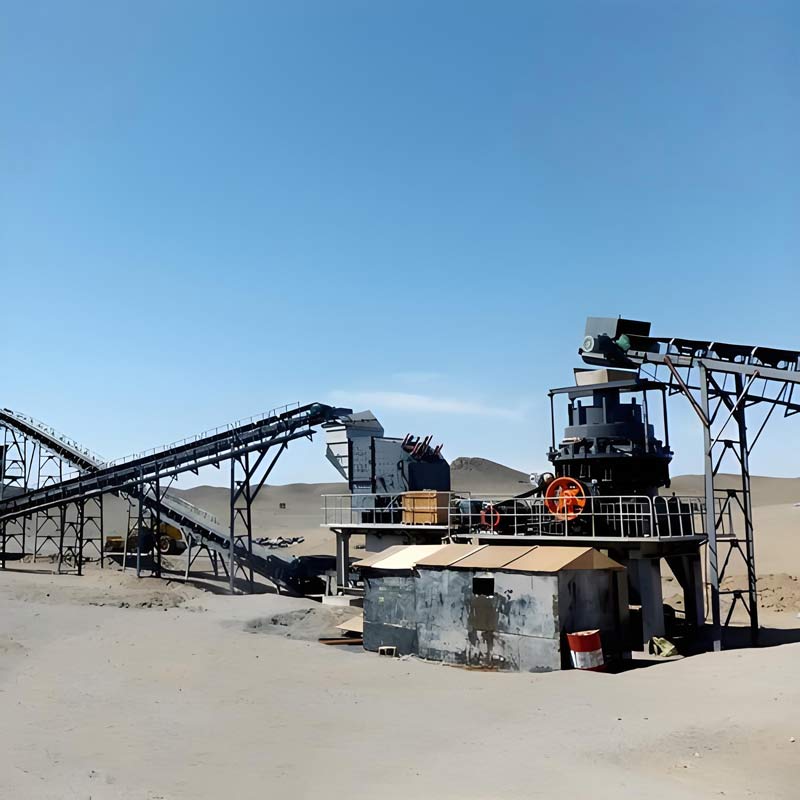
Before quartz sand flotation, washing, desilting, or the removal of iron-bearing minerals is generally required using methods such as vibrating tables or magnetic separators. Prior to flotation, the quartz is vigorously agitated in a concentrated suspension to remove the thin layer of iron oxide from its surface. A fatty acid collector is then used to separate the iron-bearing minerals, and the product remaining in the tank is the quartz concentrate.
Quartz sand has a complex composition, often containing mica, feldspar, and clay minerals, in addition to iron-bearing minerals. Based on its composition, the quartz sand flotation process can be classified into eight types:
(1) Flotation of mica first, then iron-bearing minerals, and finally feldspar. The pulp pH is adjusted to 3-4 with sulfuric acid, and the mica is floated using an amine collector. Next, the pulp pH is adjusted to 4-5 with hydrochloric acid, and the iron-bearing minerals are floated using sulfonated petroleum as a collector. Finally, the pH is adjusted to 2-3 with hydrofluoric acid, and the feldspar is floated using an amine collector. Quartz is obtained as tailings.
(2) Flotation is carried out in the following order: iron-containing minerals, mica, and feldspar. The order of the collectors used is sulfonated petroleum-amine-amine.
(3) Flotation of the iron-containing minerals first, and then of the feldspar, with quartz concentrate as tailings. This method is suitable for quartz sand with low mica content.
(4) Only iron-bearing minerals are floated, and the resulting tailings are quartz concentrate. Tall oil is used as a collector, and sodium carbonate is used to adjust the pH to 8–9. After flotation of the iron-bearing minerals, the tailings are quartz. This simple process is advantageous when the raw ore contains no mica or feldspar, or when it contains little feldspar and separation is not required.
(5) When the quartz sand contains a high amount of feldspar, adjust the pulp pH to 7-8, use fatty acids as collectors to float the iron-bearing minerals, and then add hydrofluoric acid and amines to float the feldspar. Finally, when the pulp pH is 7-8, use amines as collectors to float the quartz.
(6) Adjust the pH of the pulp to 7-8, use sulfonated petroleum to float the iron minerals, and then use amines to float the quartz when the pH of the pulp is 7-8. This method is suitable for situations where the raw material does not contain feldspar or its content is very low, making separation unnecessary.
(7) Use amines as collectors to mix and float the quartz and feldspar. When separating the mixed concentrate, add hydrofluoric acid and amines to float the feldspar. The tailings are quartz concentrate.
(8) After iron ore flotation, perform a mixed flotation of feldspar and quartz. This method is suitable for quartz sand with high iron content.
Related Products
Inquiry
Please leave us your requirements, we will contact you soon.