

How to effectively reduce noise pollution from ball mills?
Ball mills are indispensable grinding equipment in industry and daily life. However, ball mill noise causes environmental pollution and reduces mechanical efficiency, posing a significant obstacle to the development of the ball mill industry. Noise reduction for ball mills can be achieved through the following five methods:
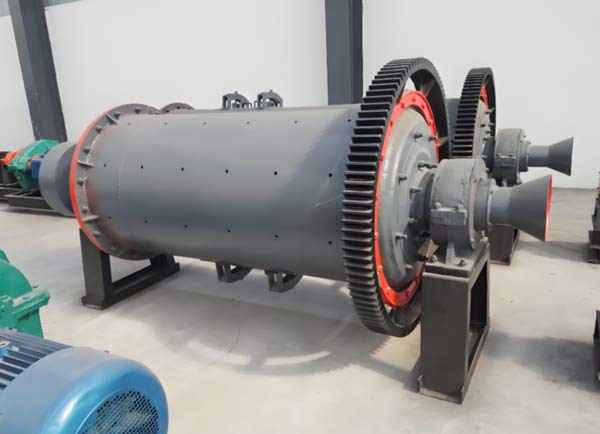
I. First, we need to design a soundproof enclosure. When our economic conditions permit, we should centralize the ball mills in a dedicated ball mill room and convert that room into a dedicated soundproof enclosure. This will be more effective than a soundproof cover, but we must pay attention to addressing issues related to monitoring the ball mill’s grinding process, indoor heat dissipation, and maintenance.
II. We can use rubber liners instead of manganese steel liners, which can reduce the noise level by 9 dB(A) and change the frequency spectrum from high to low frequencies.
III. Install an elastic layer. A heat-resistant soft rubber pad is placed between the inner surface of the ball mill drum and the liner. To prevent the soft rubber pad from overheating, a 10-15 mm thick layer of industrial felt is placed between the ball mill liner and the soft rubber pad. This can reduce the ball mill noise below the permissible standard.
IV. Add a soundproof enclosure to the ball mill. Use a steel frame with a thin steel plate outer shell, lined with a damping layer and filled with ultra-fine glass wool or other sound-absorbing materials to completely enclose the ball mill. Since the ball mill generates a large amount of heat during operation, it is essential to address heat dissipation within the enclosure and ensure easy equipment maintenance.
V. Wrap a sound insulation layer around the drum wall. Wrap a 50mm thick layer of industrial felt around the outside of the ball mill drum wall, with a 1.5mm thick steel plate as the facing. Secure it to the drum wall with bolts. The actual sound insulation value is approximately 12dB(A). If the ends of the drum are treated similarly, and the seams of the wrapped drum wall are properly sealed, the sound insulation effect may be further improved.
Related Products
Inquiry
Please leave us your requirements, we will contact you soon.