

Basic Structure of a Gyratory Crusher
A gyratory crusher, also known as a compound crusher or vertical compound crusher, is a type of medium and fine crusher.
There are basically three types of gyratory crushers: fixed, inclined discharge, and center discharge. Due to the numerous drawbacks of the first two types, my country only produces center discharge gyratory crushers.
The frame of a center discharge gyratory crusher consists of a base, a central frame, and crossbeams, all bolted together. The crusher’s base is mounted on a reinforced concrete foundation.
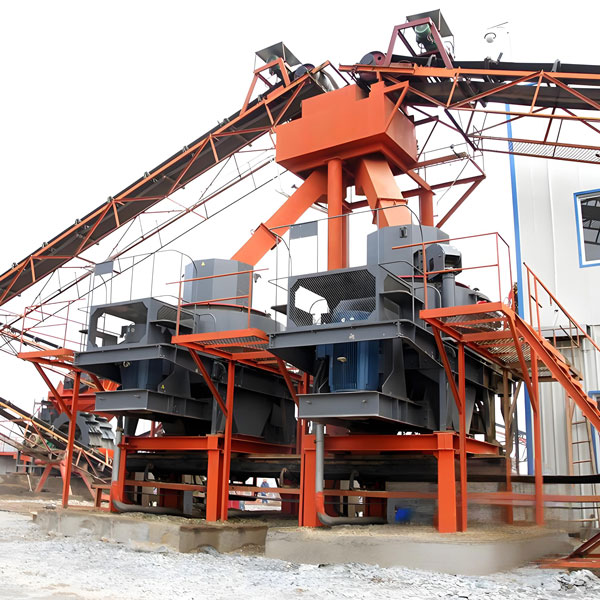
The working mechanism of a gyratory crusher consists of a crushing cone and a fixed cone (middle frame). The inner surface of the middle cone is inlaid with three rows of parallel manganese steel liners. The bottom row of liners is supported on the protruding part at the lower end of the frame, while the top row is inserted into the convex edge at the upper part of the middle frame. This allows it to withstand the thrust and vertical component of the crushing force generated by friction during crushing. The middle frame and liners are sealed with a zinc alloy (or cement).
The outer surface of the crushing cone is fitted with three annular manganese steel liners. To ensure tight contact between the liners and the cone, a zinc alloy is poured between them, and the upper part of the liners is secured with nuts. A locking plate is installed on the top of the nuts to prevent loosening.
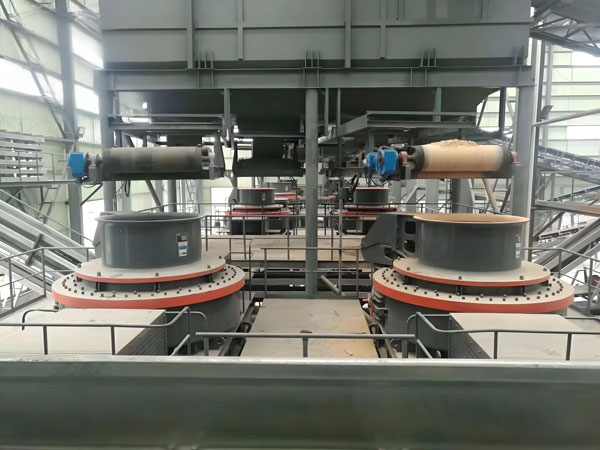
The crushing cone is mounted on the main shaft, whose upper end is suspended from the crossbeam by a conical nut, a conical pressure sleeve, a bushing, and a support ring. A wedge key is also installed on the conical nut to prevent loosening. The bushing is supported on the support ring by its tapered end, while its sides are supported on the inner surface of the conical bushing. During crusher operation, because both the lower end of the bushing and the inner surface of the conical bushing are conical, the bushing rolls along the support ring and the conical bushing, thus satisfying the requirements of the crushing cone’s oscillating motion.
The lower end of the main shaft is inserted into the eccentric hole of the eccentric bushing, which is eccentric to the crusher’s axis. When the eccentric bushing rotates, the shaft of the crushing cone moves in a conical motion with the fixed suspension point on the crossbeam as its diameter, thereby generating the crushing action.
Related Products
Inquiry
Please leave us your requirements, we will contact you soon.