

Ball mill working method
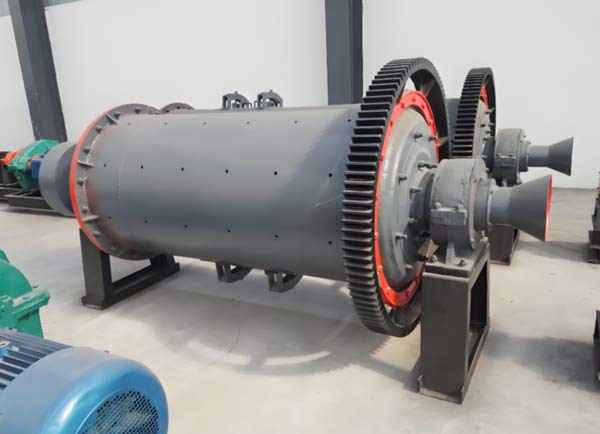
The most common grinding process for ores currently involves ball mills, which are horizontal cylindrical mills. The cylinder contains crushing media of various diameters (steel balls, steel rods, and gravel, etc.). As the cylinder rotates around its horizontal axis at a specified number of revolutions, the crushing media and the ore inside, under the influence of centrifugal force and friction, rise to a certain height along the cylinder wall and then detach from the wall, falling freely or rolling down. The grinding of the ore mainly relies on the impact force of the falling crushing media and the abrasive action of its movement.
The ore is continuously fed into the cylinder through a hollow shaft at one end, while the ground product is continuously discharged through the hollow shaft at the other end. The movement of the ore inside the cylinder is achieved by the pressure of the continuously fed ore. In wet grinding, the ore is carried away by the water flow. In dry grinding, the ore is carried away by the airflow drawn out of the cylinder.
There are generally two methods for discharging ore in grinding mills: center discharge and grate discharge. Center discharge allows the ground product to overflow freely through the hollow journal at the discharge end. Therefore, the level of the slurry in the cylinder must be higher than the level of the lower generatrix of the discharge journal. Grinding mills with center discharge are called overflow ball mills. Grate discharge involves installing discharge grids at the discharge end of the cylinder, and the ground product is discharged through holes at the outer edge of the grids. Grinding mills with grate discharge are called grate-type ball mills. Besides these two methods, there is also peripheral discharge, which discharges ore through the perimeter of the cylinder, but this is rarely used nowadays.
Related Products
Inquiry
Please leave us your requirements, we will contact you soon.